


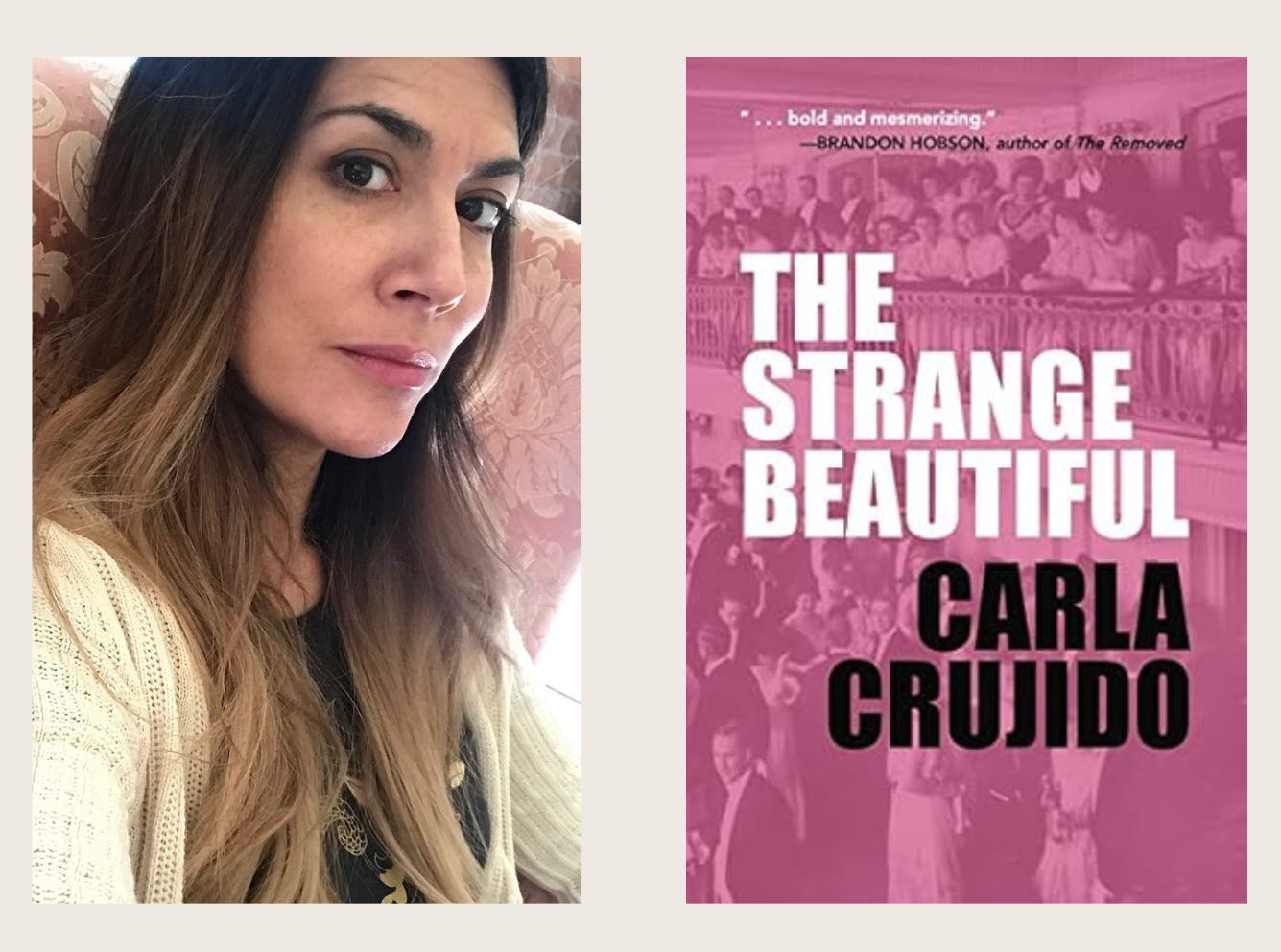
Carla Crujido’s stories capture the seen and unseen, moments lost to time, and the way one place can host a multitude of narratives. Crujido’s debut fiction collection The Strange Beautiful was published by Chin Music Press in September 2023. This stunning collection is intertwined, historically rich yet fairytale-inspired, and centers on the Mount Vernon Apartments in Spokane, Washington, offering a glimpse into the lives of ten tenants over a period of one hundred years. These apartment’s inhabitants with overlapping storylines are vividly alive with beauty, loss, yearning, mystery, and magic.
Author Chelsea Hicks writes of The Strange Beautiful, “Carla Crujido conjures. With these dark, sexy, haunting modern fairy tales, she evokes and transcends West Coast nostalgia, glamor, and all the ways the past is never past. Crujido will leave you dreaming, craving more of her mesmerizing prose and her enchanted places, ghosts, and characters.”
Carla Crujido lives in the Pacific Northwest and was the Nonfiction Editor at River Styx Magazine. She holds an MFA in Creative Writing from the Institute of American Indian Arts. Also, she’s food-obsessed and when she’s not writing transportive fiction, you can find her writing culinary articles.
I had the pleasure of speaking with Carla virtually (2023) where we discussed Spokane’s magic, repetition of history, forgotten everyday women, and the divine combination of red wine and huckleberry chocolate.
You noted in an interview with Chin Music Press that The Strange Beautiful is a love letter to Spokane and an homage to places that no longer exist. Although every city changes with time, Spokane feels like an interesting and compelling choice — very different than if it was San Francisco or New York. Maybe because it doesn’t get much attention? What about Spokane captured your imagination?
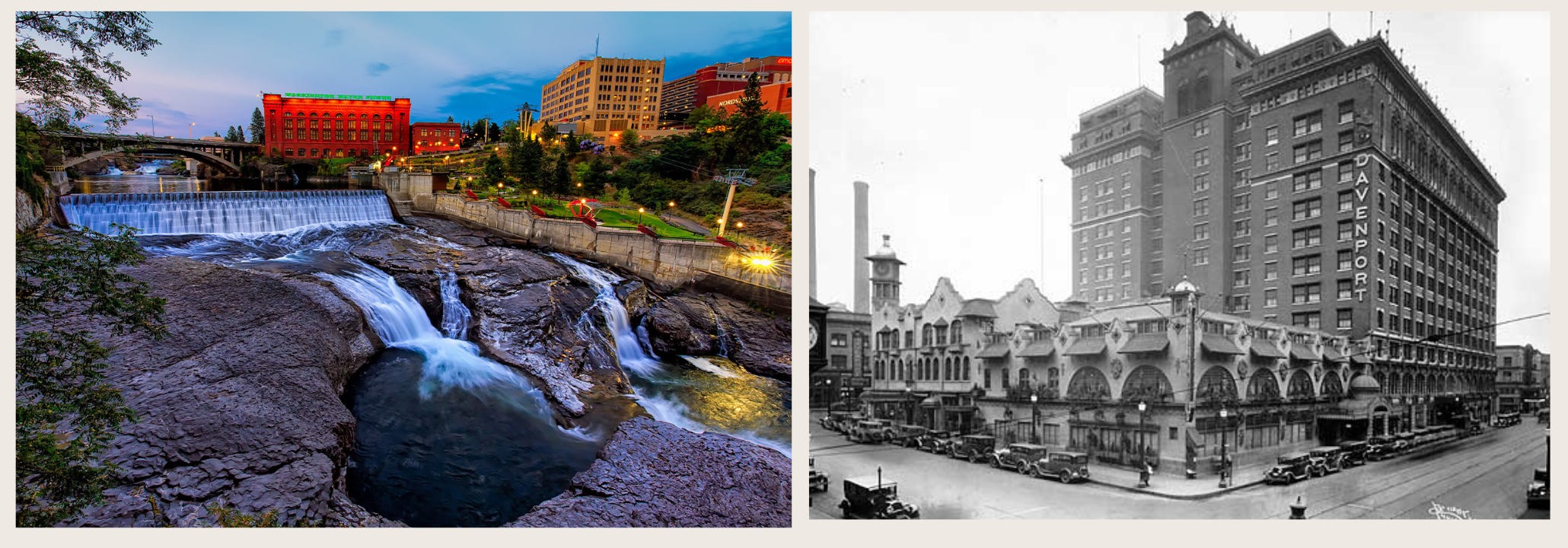
I would not exist if not for Spokane. It’s where my mom and dad met (which is a fairy tale unto itself) in the very early ’60s. After they married and moved to California, we would still return every year to spend summers with my Grandma Blondie in Priest River, Idaho. These trips included days spent in Spokane: Auntie’s Books, ice cream at the once-upon-time shop in the Parkade, errands down Division, burgers at Steer Inn, sometimes lunch at Cyrus O’Leary’s. My father was a nuclear engineer and we power plant-hopped all over the country, but Spokane and Priest River were a constant for me. They always felt like home. Beyond that, I love the history, both remembered and forgotten, of Spokane. If I never wrote about another city, I’d never run out of stories.
Disappearance, reappearance, nostalgia, an inevitable interconnectedness . . . It’s also notable that the first few stories take place in 1918 during the Spanish Flu epidemic. The isolation and rules that come with an epidemic or pandemic are now intimately familiar for us. I believe you started writing these stories prior to Covid. What did that trajectory look like?
Disappearance, reappearance, nostalgia, and inevitable interconnectedness speak to everything that I and my work represent in life and on the page. One of my best friends, Richard, says he never knows when I will disappear or reappear (and sometimes he means it quite literally). I am also one who gets lost in the past. That is not to say, I pine for my own past (I don’t); I pine for what has been lost to me that I never knew — history, stories, people. It’s why I write the stories I do. To capture those lost people and moments of time.
I did start writing three of the ten stories before Covid, including the first story “The Songbird.” It was born purely from history and not experience. Thomas’ story came to me while watching Richard’s storyline in Boardwalk Empire, although in my mind my Thomas looked and acted more like Thomas in Downton Abbey. Once a character introduces him or herself to me, I open the door and welcome them in. Thomas started talking and I started taking notes. Then I did a deep dive into researching Spokane during the Spanish Flu, and after that I started writing. “The Tower” which was also set in 1918, was written at the height of our own pandemic, but I didn’t want to write a 2020 pandemic story. We were living it; it felt too depressing.
However, I was astounded by the similarities and also by the differences, because people had such good manners for the most part back then. If you spat on the street, you got in trouble. You didn't get arrested but you did get a ticket for spitting. You got a ticket for not being masked. People still snuck out and did things that they weren't supposed to do (human nature), but still, people respected the rules a lot more than they did this time around. I thought that was fascinating.
Originally “The Songbird” was supposed to be the first story and “The Tower” the last. I wanted to make the point that history is cyclical and forever repeating. However, the collection had its own ideas about how it wanted to be read.
The fairy tale elements work beautifully. The stories are a perfect mix of the everyday, the human, and the magical. The surreal elements are never jarring and it all feels gorgeously natural and nuanced. In “The Bear” Boris the bear says, “Being seen is its own kind of magic” and this line feels like a driving theme or a poetic summary of the collection. Do you often infuse your fiction with fairy tales? Or was this a choice that felt necessary for this collection and the work it’s doing?
Thank you! I think all of us really want it to be seen and so often we aren’t. For some of us that means being seen on social media, but for most of us it’s about being seen offline, in a real way.
I didn’t even think of infusing my fiction with the surreal or fairy tale elements until my then mentor, now friend, Toni Jensen was reading a chapter for a back-burnered historical novel I was working on and she read the almost imperceptible nod I made to the surreal and she suggested I write into it.
Later, a friend of mine gave me a copy of Mouthful of Birds by Samanta Schweblin and told me it reminded him of me. After I read it, my writing changed completely. Prior to reading that book, I was writing about Mount Vernon in Spokane, but it was a historical novel. It was a fast and intuitive change of direction and led to the stories in the collection. As soon as I delved into the surreal, it just broke apart, and I was so in love with my characters in the research and the writing. I haven't been able to get back to that.
Writing in that manner also freed me from myself. It allowed me to get to the truth of the story, to muddy up my characters, to be real. Metaphor goes a long way in allowing me to write what otherwise feels impossible.
You render a variety of characters flawlessly, but I was moved by your repressed or “erased women.” Along with Spokane, it seemed like perhaps you were trying to keep some women’s stories alive: neglected wives, unseen women, women who want to fly away, men who try to keep “a woman without a suitcase of broken emotions,” a mannequin who learns that being a woman is a lot of “do not’s.” Can you say more about your century of fascinating women?
I love that you got all of that. It was my intention to make sure that I conveyed how the stories of everyday women are erased or forgotten or never even told. It hit me extra hard when I lost my Auntie Helen last summer. She lived a life worthy of a novel, but if I didn’t tell her story who would? Ditto, one of the characters in the book who was based on a real woman who lived at Mt. Vernon. She’s been erased with the passing of time. Until now. Although I didn’t write a novel about her, as originally planned, she still appears in two of my stories (and on the cover of my book), so she will never be forgotten. It also felt important to shine a spotlight on the fact that women have never been treated as equals.
This collection is very autobiographical. I write about women in my family or experiences that women had. I think about my mom, who's now 83, and when she lived in Spokane in her 20s she couldn’t have her own credit card. She could get her own apartment there (she lived in Mount Vernon), but she couldn't get a bank loan. It wasn't polite for women to smoke. It wasn't polite for women to drink beer, definitely not out of a bottle. And, my mom's a tavern owner's daughter. My grandpa owned taverns in Sandpoint and Priest River. But there were just so many things even in the ’60s — then you take it back to the time of my grandma and great-grandma … I still think about the things they weren't allowed to do as women.
I think of the stories of the women within my own family and how society didn’t think their stories were worth remembering. Those are the stories that I feel need to be told — quiet stories of quiet women, men, and . . . animals. Love you, Boris!
You hold an MFA from the Institute of American Indian Arts. How was that education formative or supportive in creating this debut collection? What path led you to IAIA?
It’s a funny story: My sister-in-law, Laurelle, invited me to attend an Indigenous Writers Conference with her in Flagstaff back in 2017, and then she ditched me (but opened a door to my future). I decided to go alone. I was late and asked to share the only table I saw with an empty chair. My table mates, Manny Loley and Brendan Basham, were both students at IAIA. Sherwin Bitsui, Joan Kane, and Kristiana Kahakauwila were on the first panel representing IAIA, and before the day was over, I knew it was where I was supposed to be. During my time there, I studied with Marie Helene Bertino, Ramona Ausubel, Derek Palacio, Toni Jensen, and Pam Houston. Talk about a rare constellation of mentors!
Also, if it weren’t for IAIA, I’m not sure The Strange Beautiful would have been published. I shopped it around to agents and indie publishers and no one was interested. I heard, “beautiful writing, but we can’t sell it” over and over and over again. When I was ready to give up, I got an email from IAIA saying Chin Music was seeking submissions. Justine Chan pulled my manuscript out of the pile and emailed me and here we are.
Beautiful. What role does abandon play in your writing? Do you write hot, edit cold? Tell me a bit about your writing life and creative process.
I live and write in organized chaos and always with abandon. The closest I get to a writing ritual is pouring a small glass of red wine, putting on my headphones, and tuning into something that’s going to set the mood for my work. It also has to be dark outside. I cannot write during the day. I absolutely write hot and edit cold! I am not one who has a daily practice. I can only write when inspired and then I write with a sense of mad abandon. I love the journal’s theme and I thought it was very fitting to me and to my work, because I write very intuitively. I’m not a linear writer. I'm not a linear human being.
Also, music is everything to me. I can’t write without it. It’s my constant. The soundtrack for the writing of The Strange Beautiful was super eclectic (Pete Yorn to Waylon Jennings to Macklemore) but leaned heavily on Nick Drake and Lana Del Rey. I also read for inspiration (mostly nonfiction for research), but I did go back again and again, while writing, to the poetry of Joy Harjo and the lyrical essays of Toni Jensen. May I say, there is no one who writes nonfiction as beautifully as Toni!
I hear you’re food obsessed. So, what dish, cocktail, and/or dessert pairs most scrumptiously with The Strange Beautiful?
If I were feeling fancy, I’d say a glass of Saviah Cabernet Franc and a slice of Torta Caprese; however, the most perfect pairing for reading The Strange Beautiful is a glass of Walla Walla red and dark chocolate huckleberry truffles from Montana. I spent many evenings staring out the window of my south-facing room of the Davenport Tower Hotel — while drinking a glass of Washington red, eating huckleberry chocolates, and writing in my mind.

Note: This interview was originally for Abandon Journal, but they aren’t currently operating. I’m very glad I connected with Carla though, read her beautiful collection, and learned more about our beloved Spokane. It’s an honor to share our chat with you. Do buy her fantastic book and enjoy it (preferably with some huckleberry chocolates).